How did Como’s Camerlata fountain travel from a Milan exhibition to a traffic circle?

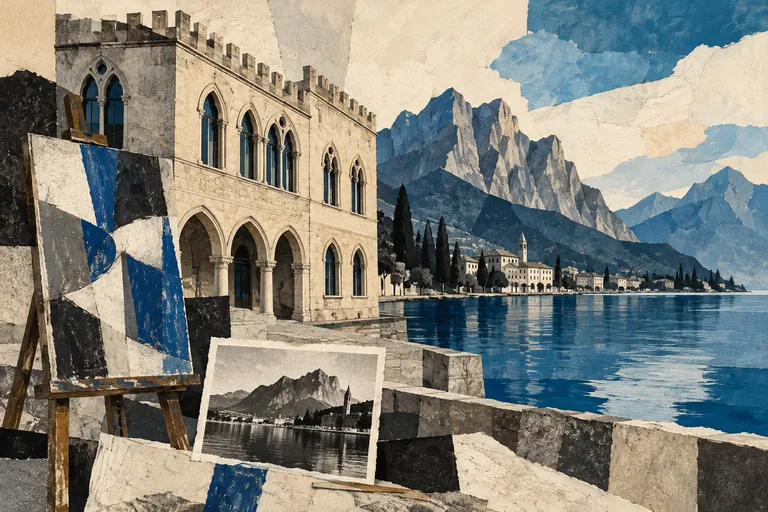
At a busy road junction south of Como’s old center, white rings seem to balance on a pile of spheres. The Fontana di Camerlata is an unusual destination for a Lake Como visitor. The road is part of the reason to see it. Architect Cesare Cattaneo and painter Mario Radice developed a composition whose open spaces and overlapping circles change as you move around the square. You can understand that idea from the pavement without trying to reach the middle of the traffic circle.
Start with the site the designers had in mind
Find Piazza Camerlata on a map before leaving the waterfront. This is an urban junction away from the pedestrian streets around the cathedral. Choose an approach with a public pavement and use the marked crossings if you want to change sides. A bus or train journey to the Camerlata area may still leave a walk to the fountain. Put the monument itself into the map instead of assuming that the station bearing the neighborhood’s name is the final stop.
From a comfortable standing place, identify one solid sphere, then follow the edge of an open ring. The sphere blocks the view behind it. The ring allows sky, plants or buildings to appear within its outline. Shift a little along the same pavement and watch what changes inside that frame. Our guide to San Carpoforo describes another destination in southern Como, useful if you want to spend more of the outing in the area after this fairly short exterior stop.
Why the first audience saw it in Milan
Cattaneo and Radice designed the fountain for Como, but an early installation appeared in Milan’s Parco Sempione in 1936 at the sixth Triennale. The Como tourism office dates the installation in its intended location to 1962. The city’s account of the fountain helps distinguish those milestones. A date attached to a historical photograph can refer to the exhibition without documenting the finished arrangement in the traffic circle you see today.
There is unusually good evidence of the project’s intermediate stages. The regional inventory of Mario Radice’s archive lists drawings, calculations, photographs of the work exhibited in Milan, correspondence with Como and postcards showing it installed in Camerlata. Imagine the different questions those objects could answer. An exhibition photograph can show the temporary setting. A plan can record where the designers wanted the rings to fall. A postcard can reveal how the finished fountain entered the ordinary visual life of its neighborhood.
Read the geometry from a moving viewpoint
The regional architectural catalogue describes a design that preserves views through the stacked elements and lets their relationships change with the viewer’s angle. Look for a moment when two rings seem to touch. From a different position the space between them may open again. The structure itself has stayed still. Your line of sight has changed. Try a quick pencil outline with just a few circles and discover how much of the fountain you can suggest with very little information.
Seeing a roundabout in the work need not mean that its makers intended a single pictorial symbol for traffic. A circular form can respond to the shape and movement of a place through its proportions alone. If the water is off or hard to see from your viewpoint, the arrangement of solids and openings still gives you plenty to study. The Como civic art gallery guide offers a different setting in which to think about abstraction and the work of artists in this area.
Decide whether it belongs in your lake itinerary
A visitor who wants a waterside afternoon can spend that time around the first basin without making this detour. Someone drawn to twentieth-century design can build a more coherent day by pairing the fountain with one other building or collection. The silk museum guide takes design down to the scale of a machine and a woven surface. For another city on the same trip, the Milan Triennale guide puts the exhibition setting into perspective.
Browse the Lake Como arts and events collection before committing to a second appointment. At Camerlata the most revealing comparison needs neither a ticket nor a close-up photograph. It is the difference between the ring you see as a thin horizontal line and the same ring opening up into an ellipse a short walk farther along the pavement.
Sources & further reading
Turn a good read into a great day.
Find a highly rated Lake Como experience that brings these stories to life.
Explore related experiences →