Varenna’s San Giorgio: what can stone, frescoes and a village square reveal?

Varenna is often introduced through its waterfront, but the square around San Giorgio changes the scale of a visit. Instead of following the edge of the lake, you are looking at a place organised around a church and village life. Inside, if visiting is possible, stone, painting and furnishings offer different kinds of evidence. The pleasure is in comparing them carefully, without assuming that everything belongs to the same century or that every opening in a busy travel day must be filled.
Which dates give your looking a reliable starting point?
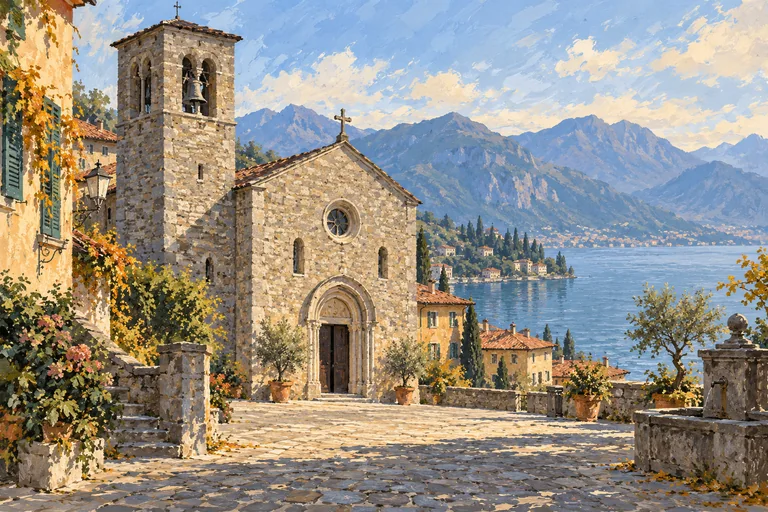
The Regione Lombardia tourism description, supplied with LakeComo.is, records San Giorgio’s consecration in 1313 and its three-nave arrangement. It draws attention to the façade’s rose window and Saint Christopher fresco, as well as the dark local stone floor. It also dates the high altar’s inauguration to 1822 after a long period of construction. These details establish an essential distinction: the medieval church and the later furnishings are related parts of one place, but they are not one building campaign.
Outside, start with the façade as a whole. Find the opening that organises the upper section, then look at the painted surface and the entrance below. Do not worry if weather, shade or wear makes a detail harder to read than an online image suggests. A photograph may have been made under different light or after a particular intervention. Your task is to notice what is visible now, and to distinguish that observation from what a historical source supplies.
What can the floor teach you?
A dark stone floor can be easy to overlook because your eyes are drawn towards paintings and altars. Give it a moment. Notice reflected light, the joints between pieces and the way the surface sets off the vertical supports. You can describe those qualities without pretending to identify a geological specimen from a polished slab. Heritage descriptions sometimes use familiar material names broadly; a visitor need not convert every such term into a precise scientific classification.
Likewise, wear is interesting but not a calendar. A smooth patch can prompt questions about repeated movement, yet it does not reveal exactly who walked there or when a stone was laid. Keep your feet where visitors are permitted, avoid touching painted surfaces, and resist the temptation to test a material with a fingernail. Close looking is an activity of attention, not an experiment conducted on somebody else’s building.
How do frescoes change the experience?
Paintings attached to architecture reward a different approach from pictures hung in a gallery. Their relationship with a wall, opening or line of sight matters. Look first at position and scale, then at surviving colour and figures. If an identification is uncertain or attributed in the source, preserve that uncertainty rather than turning it into a settled portrait. You do not need to recognise every figure to notice how the imagery changes the character of the space.
For a comparison on a wider trip, Milan’s San Maurizio offers another way to think about painting and architectural divisions. It is a comparison of looking methods, not a claim that the churches share the same history. Here in Varenna, allow time to sit quietly if that is appropriate, and remember that a church’s devotional use takes priority over a visitor’s preferred photographic angle.
How should the square fit your Varenna route?
Our guide to Varenna beyond the waterfront helps connect a short church visit with the rest of the village. If you are considering Villa Monastero, verify the house and garden’s respective opening arrangements for your date. A further excursion to Castello di Vezio adds a different physical demand; it is not simply another flat village stop. Choose the combination that suits your energy and the available daylight.
San Giorgio’s current visitor access should be checked locally or with the parish; a past brochure is not a dependable opening guarantee. If it is closed, the square and exterior still make a useful pause. Keep a return journey in view as well. Use Navigazione Laghi’s official schedules for the actual service you need, and distinguish Varenna from Bellagio, Menaggio and Como city. The lake is a network of places, not one interchangeable departure point.
Browse the Lake Como experience collection if you would like a guided visit, checking where each activity starts and what it actually includes. A Milan departure does not become a Varenna departure merely because the itinerary reaches the village. With that practical distinction settled, the church can remain what makes it valuable: a chance to look at a particular place, at a human pace, rather than another stop in an overfilled circuit.
Sources & further reading
Turn a good read into a great day.
Find a highly rated Lake Como experience that brings these stories to life.
Explore related experiences →