Colico’s Forte di Fuentes: how do you plan a visit to a ruined fort above Lake Como?

Forte di Fuentes is a visit to ruins on the upper lake, not a promise of rooms furnished as a working fortress. That distinction makes the experience more interesting. Surviving walls, changes of level and the relationship between the site and its surroundings invite you to work out how a fortified place was organised, while recognising how much has disappeared.
Plan it as a specific excursion from Colico. Reaching the town, arriving at a lake landing stage and reaching the fort are separate stages of the day. Before choosing transport, check the opening arrangements for the fort itself and decide whether the walk and terrain suit your party.
Why was a fort built here?
Visit Colico’s official introduction connects the fortress with the Spanish government of Milan and the strategic position near the northern end of Lake Como. Construction began in 1603 under the governor whose title gave the site its name. The Italian cultural ministry’s archival account of Colico independently places the beginning of the fort in that year.
This history is a useful corrective to the idea that a lake landscape has always been principally about leisure. Routes through the surrounding valleys made movement, boundaries and control important here. From a visitor’s perspective, start with the large questions: where could people approach, what could be watched, and why did this piece of ground matter? You do not need to identify every broken wall to begin understanding the site.
Let the missing buildings remain missing
The fort’s later destruction helps explain why the visit feels different from an intact castle. Use interpretation panels or a guide to distinguish an identified building from your own visual guess. A rectangular space may suggest a room, but its purpose cannot safely be read from shape alone.
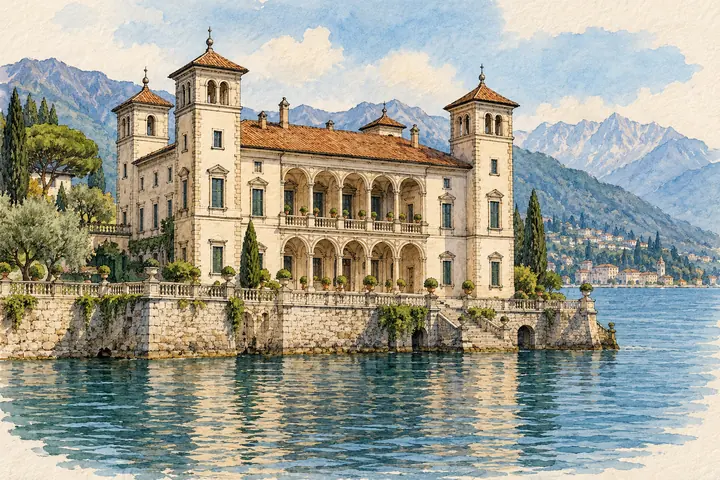
The regional heritage record for the remains of Santa Barbara documents a church within the fortified complex. That is a reminder to look beyond weapons: a military settlement also needed places for daily life and worship. Our illustration is an imagined editorial study of ruined walls, rather than a reconstruction of the fort or a plan you can follow on site.
Pause at a point where several walls can be seen together. Look for differences in height, openings and the meeting of surfaces. Then check what the interpretation actually identifies. The pleasure is in moving between observation and evidence, not in confidently naming everything before reading a label.
Choose the right fort
Colico has another important military site. inLombardia’s account of the town distinguishes Fuentes from Forte Montecchio Nord, a much later fort associated with the early twentieth century. They should not be treated as two names for the same attraction.
Our guide to Forte Montecchio Nord explains that separate visit. Check tickets, entry arrangements and transport independently if you want to see both. Photographs of preserved military equipment at one site do not describe what survives at the other. For a broader architectural contrast on a different day, Milan’s Sforza Castle shows how a fortress can acquire further roles in a city.
Match the calendar to your actual date
Checked on 27 October 2026, Visit Colico’s Italian calendar lists October weekend opening. Its November section carries an inconsistent year heading, so confirm November arrangements directly with the operator rather than assuming those entries apply to your date. The October listing does not make the fort a walk-in attraction on every autumn weekday. Consult the current calendar and ask about reservations if your proposed date falls outside ordinary opening.
Keep the date alongside any hours you write down. A screenshot without its month can be surprisingly misleading. Also distinguish an individual visit from a reserved group arrangement: a group option is not evidence that the same service will be waiting for a lone visitor. Prices, guided elements and any conditions should be checked directly before committing to the journey.
Leave room for the last part of the journey
Ask about the approach, surfaces and any limitations that matter to your party before setting off. A hillside ruin is not equivalent to a level museum gallery. Suitable shoes, weather protection and a realistic turning-back decision are more useful than a tightly packed list of viewpoints. Do not climb surviving masonry to improve a photograph.
Visiting Piona Abbey near Colico is another distinct upper-lake outing, with its own access and purpose. Farther along the lake, Dongo’s End of WWII Museum concerns a different historical period; combining names on a map should never flatten those differences.
Our Lake Como experience collection can help you compare transport and guided options. Read the exact departure point and named stops, and do not assume that a general lake excursion enters Fuentes. A successful visit begins with the right fort on the right day, followed by enough unhurried time to make sense of what remains.
Sources & further reading
Turn a good read into a great day.
Find a highly rated Lake Como experience that brings these stories to life.
Explore related experiences →