Dongo’s Santa Maria in Martinico: how do you read a church shaped by restoration?

Santa Maria in Martinico invites a useful pause in Dongo: a church can look convincingly old while also bearing the decisions of much later restorers. That does not make it less interesting. It gives you two histories to consider together, the history of the building’s earlier forms and the history of what later generations chose to reveal, remove or rebuild.
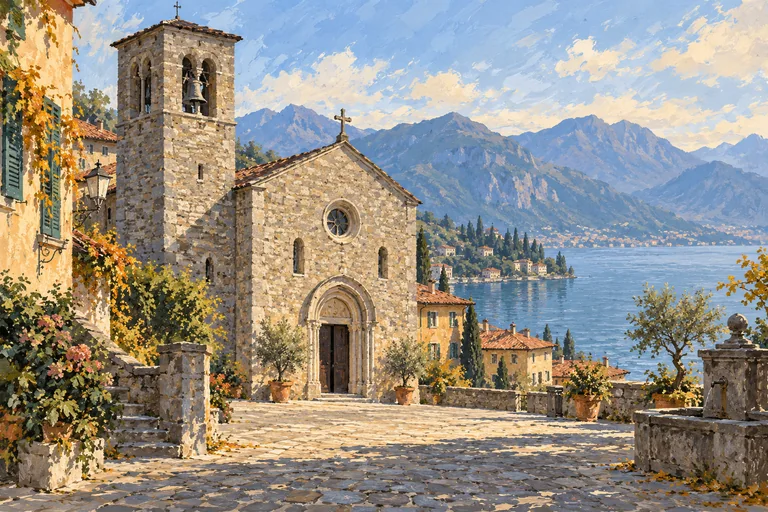
Martinico is part of Dongo, on the western side of upper Lake Como. Plan for that specific destination rather than treating every lakeside church as a short addition to a Como-city walk. The setting, the route from your arrival point and the possibility of current church use all belong to the visit.
Begin with what the regional record establishes
Lombardia Beni Culturali’s architectural record identifies the church at Piazzetta Anna Vertua Gentile and documents its existence from the twelfth century. It associates parts of the masonry and sculpted elements of the northern portal with the Romanesque phase. This is a more useful foundation than trying to assign the whole visible building a single age.
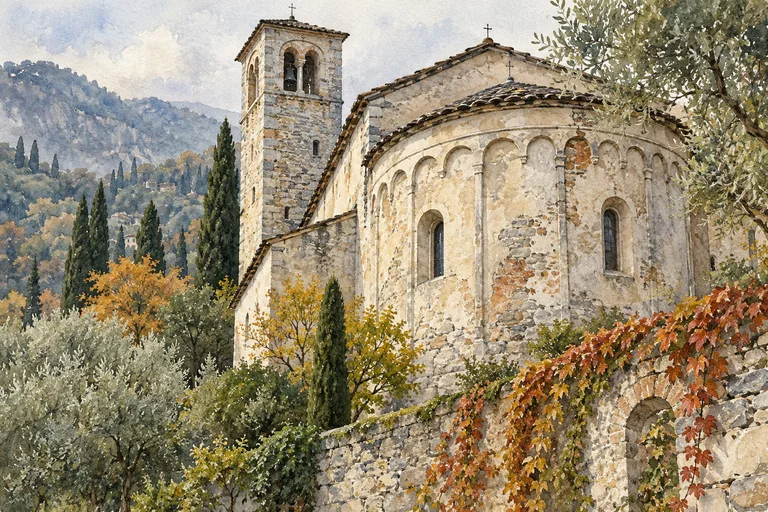
From public space, look at the rhythm of the stone courses, the openings and the relationship between wall and roof. Where can you distinguish an architectural feature clearly, and where are you simply responding to a general impression of age? You do not need to solve every change in the masonry. A careful description is already a worthwhile result.
Do not touch or trace carved surfaces in order to understand them. Changing your position slightly may reveal a shape more effectively than moving closer. Keep residential access clear and remember that a small church is part of a lived neighbourhood, not an isolated object arranged for visitors.
Understand why the present outline needs a second date
The regional catalogue records major work under Federico Frigerio from 1905, including removal of later additions, reconstruction of the apse and detachment of frescoes. Further work in 1912 rebuilt the bell tower and sacristy on the southern side. The visible composition therefore cannot be treated as an untouched medieval arrangement.
That history changes the question you ask. Instead of “Is this all original?”, try “Which phase does the information identify here?” An apse, tower, painted fragment and adjoining wall may each require a different answer. A restoration can make one period easier to imagine while reducing the visibility of another. Recognising that choice helps you look with greater precision.
It also prevents a familiar shortcut: using a building’s appearance as proof of a continuous, unchanged local tradition. A church’s long life includes adaptation. Later interventions are evidence of that life, even when their aim was to recover an earlier architectural character.
If the interior is open, look at fragments as fragments
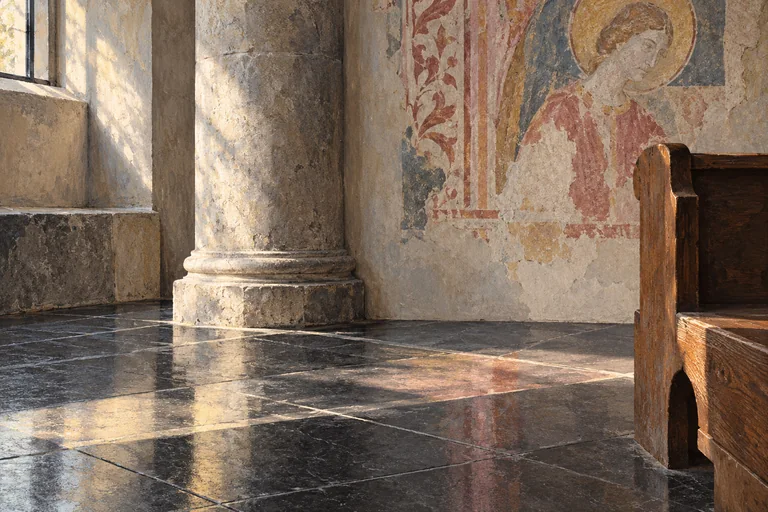
The catalogue describes successive phases of wall painting and detached fresco portions. Its chronology distinguishes medieval material from later decoration. Use current labels or an authorised explanation to identify particular works, rather than assigning a date from colour or apparent wear alone.
A fragment can ask more of your imagination than a complete scene. Begin by identifying what is actually present: part of a figure, a border, an area of painted architecture. Then notice what the display tells you about the original location and subsequent treatment. Missing areas should remain missing in your account unless reliable interpretation supplies the connection.
Detachments and redisplays also affect how a painting is encountered. Something once integrated with a wall may now be easier to examine as an individual object. Ask what becomes clearer and what relationship with the original setting is harder to recover. That is an observation about presentation, not a licence to reconstruct an entire lost interior in your head and call it fact.
Keep access information separate from historical documentation
The regional record is valuable historical evidence, but its dated survey is not a current opening timetable. Confirm access with the parish or current local visitor information before making an interior visit essential to your day. Worship, maintenance or a private service may change what is possible. An architectural catalogue does not reserve a place for you.
Check the approach and entrance against your mobility needs rather than assuming that a small village church is step-free. If the interior is unavailable, an exterior visit can still support the central question about the building’s changing form. Do not seek an alternative entrance without permission or turn a closed door into a reason to disturb neighbouring homes.
Choose a Dongo day with a clear focus
Our Dongo museum guide introduces a very different period of local history. Give each subject its own attention rather than forcing medieval architecture and twentieth-century events into one simplified narrative. Santa Maria del Tiglio in Gravedona offers another architectural comparison, while the Piona Abbey guide helps plan a separate religious-site visit.
For a later Venice journey, San Giobbe raises related questions about how moving artworks changes a church encounter. Compare organised lake outings through our Lake Como experience collection, checking the actual departure town and named stops. A lake cruise does not automatically include Dongo or Santa Maria in Martinico. Leave with one detail you understand more carefully, and with room for the building’s several histories to remain visible.
Sources & further reading
Turn a good read into a great day.
Find a highly rated Lake Como experience that brings these stories to life.
Explore related experiences →