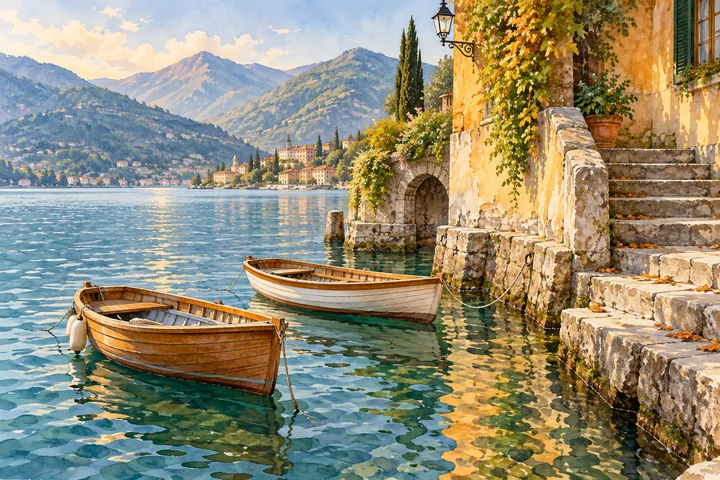
Rezzonico on Lake Como: what can you explore around the private castle?

Rezzonico’s castle is a strong visual landmark, but it is not an automatic admission ticket. The village belongs to the municipality of San Siro on Lake Como’s western shore, and its public lanes can make a rewarding outing without entry to the private castle. Plan around what is genuinely available: the village setting, the relationship between houses and water, and a transport connection you have checked for your own date.
What does private castle mean for a visitor?
The Comune di San Siro’s castle record describes the building as a private residence, with public opening associated with special events. That is not a standing invitation to enter the grounds, nor evidence of a particular event taking place today. Unless a current, authorised announcement confirms an opening and its conditions, regard the castle as something to appreciate from lawful public viewpoints.
The municipal account places the fortified complex’s medieval development in the fourteenth century while acknowledging a longer history of the site. For a first visit, you do not need to turn uncertain earlier origins into a dramatic founding story. Look at the relationship between the defended enclosure, its elevated position and the surrounding settlement. The distinction between a whole fortified area and a single tower is more useful than a string of unsupported anecdotes.
A closed gate is part of the present-day reality of the place. It does not make the rest of the visit a consolation prize. Some of the most interesting questions concern how a conspicuous private landmark shares a landscape with ordinary streets, homes and places used by the public. Stay on signed public routes, respect residential entrances and resist the temptation to improve a photograph by stepping into someone’s space.
What should you notice in the village?
The Comune di San Siro’s village record describes houses beside descending steps, porticoes and the lakeside setting. Use those elements to shape a small looking exercise. Follow one public lane at an unhurried pace and notice the transitions: open view to enclosed passage, brighter stone to shadow, houses facing each other to a sudden glimpse of water.
Ask practical architectural questions before inventing historical answers. How does the route deal with the slope? Where is there room for people to pass? Which threshold clearly belongs to a home? These observations help you read the village as a lived place. They do not prove the original function of every recess, stair or arch. If a detail particularly interests you, photograph it only where permitted and look for reliable local information afterwards.
Uneven surfaces and changes in level deserve attention. Choose shoes suited to stone lanes, and do not assume that a short distance is a step-free one. If mobility is a concern, ask the local visitor service about the exact route and parking or drop-off arrangement you intend to use. Information about an accessible entrance during a special castle event should not be generalised into a promise about the whole village.
Should you add the lakeside to the walk?
Let the conditions on the day decide. A place beside the water can be attractive without being a suitable swimming spot or an uninterrupted promenade. Keep back from edges when surfaces are wet, and follow local signs. Do not infer bathing supervision, water quality or a maintained path from an appealing photograph. A comfortable place to pause and look may be all the lakeside portion needs to offer.
For comparison, our slow Menaggio walk explores a different western-shore settlement. Dervio’s waterfront and Torre di Orezia belongs to another shore and another journey. Lake views can make opposite towns seem close enough to link casually, but transport connections need to be checked rather than supplied by the eye.
How do you arrive and leave without overcomplicating the day?
Confirm the actual public-transport stop, driving approach or booked meeting point before leaving. Do not assume that Rezzonico has a ferry departure simply because a route planner shows nearby lake services. If you intend to use a boat for part of the journey, consult the official Lake Como timetable for the named pier and date. Allow for the land connection to that pier as a separate part of the plan.
Similarly, do not treat the road along the shore as a guaranteed continuous, comfortable walking route from Menaggio. Our guide to choosing a Lake Como base helps put these local journeys into a wider itinerary. Review the exact starting town in our experience collection, and distinguish a lake departure from a Milan excursion.
On a multi-city trip, Verona’s Palazzo Barbieri offers another reminder that an interesting exterior need not promise unrestricted interior visiting. Rezzonico works beautifully with the same clarity: public village first, private boundaries respected, and any special opening treated as a separately verified opportunity.
Sources & further reading
Turn a good read into a great day.
Find a highly rated Lake Como experience that brings these stories to life.
Explore related experiences →