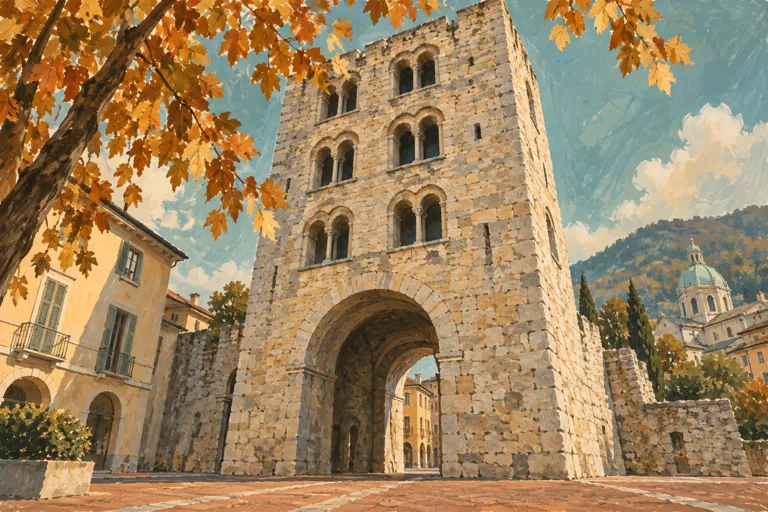
What should you notice around Como’s Broletto?

Como’s Broletto deserves a pause even if your main reason for visiting the city is the lake. Beside the cathedral, it introduces a different subject: how a town made civic government visible. Look at the arcades, the upper facade and the attached tower, then step back far enough to understand their relationship with the surrounding buildings. You can learn a good deal from this exterior encounter without expecting an always-open museum behind the doors.
Begin with the civic role
Como’s municipal cultural portal describes the Broletto as a medieval building, with later Gothic additions, used by the town’s institutions from the thirteenth century. It also explains that the tower’s bell called public assemblies. Those two facts help animate the architecture. A bell could gather people without a printed invitation; a prominent building could give public authority an address that everyone recognized.
Try looking at the structure first as a place where people met, waited and moved rather than as a flat architectural picture. The shaded area below and the enclosed level above create different kinds of space. You do not need to assign an exact medieval activity to every corner. Simply distinguishing circulation from enclosure makes the building easier to read and keeps speculation separate from documented history.
Notice the close company of cathedral and town hall
The municipality places the Broletto in the city’s religious quarter, between the cathedral and the bishop’s residence. This proximity is the most useful thing to carry away. Civic and religious buildings were not isolated objects on separate sightseeing lists; their positions helped organize the same urban centre. Standing here, you can see how several forms of authority occupied a compact area.
For a closer account of the neighboring monument, use our guide to reading Como Cathedral. Keep the two visits distinct. Looking at exterior stonework is not the same as entering a working place of worship, and an accessible square does not establish the accessibility or opening arrangements of every building around it.
Look at pattern, then look for changes
The Broletto’s contrasting stone is an excellent subject for unhurried observation. First notice the overall rhythm: light and darker bands, repeated arches and the sequence of openings. Then look for places where the rhythm changes. A joint, a different surface or a change of level may prompt a question, but it is not by itself a complete historical explanation. Let a label, a guide or a reliable architectural account supply the interpretation.
A useful travel-notebook exercise is to draw just one arch and the opening above it. Artistic skill is optional; sustained attention is the point. You will often notice proportions while sketching that disappear when you take a quick photograph. If you prefer photographs, avoid stepping into other people’s path for the perfect angle, and leave entrances clear. The square is part of a living city.
Do not plan on climbing the tower
The municipal access notice is explicit: the tower is not visitable, and the hall opens in connection with exhibitions or displays. Treat that as a planning boundary. Check the current city events listings if you hope to go inside, but do not build a day around an assumed permanent exhibition. An exterior visit still has a coherent subject and does not become a failed visit because an interior is closed.
This makes the Broletto a useful flexible stop before or after a confirmed booking. Our guide to a short Lake Como visit explains why a small, well-located plan can work better than crossing between several towns. You might combine this square with one indoor visit and a relaxed lunch, leaving the waterfront for the part of the day with the best light.
Connect the medieval city with earlier and later Como
History in Como did not begin with the Broletto, and it did not end when the building ceased to serve its original purpose. Our introduction to Roman Como and the Plinys offers an earlier layer. Read the two subjects together while resisting the temptation to imagine that every visible street or wall belongs to a single period.
If you want help making those distinctions, compare Lake Como walking experiences by their actual town and route; a lakeside village walk may never enter central Como. Travelers continuing to Turin can use Turin’s Porta Palatina guide for another exercise in reading a city’s surviving fabric. At the Broletto, the most satisfying first result is simple: you leave knowing what the building did, what you observed yourself, and which questions remain worth asking.
Sources & further reading
Turn a good read into a great day.
Find a highly rated Lake Como experience that brings these stories to life.
Explore related experiences →